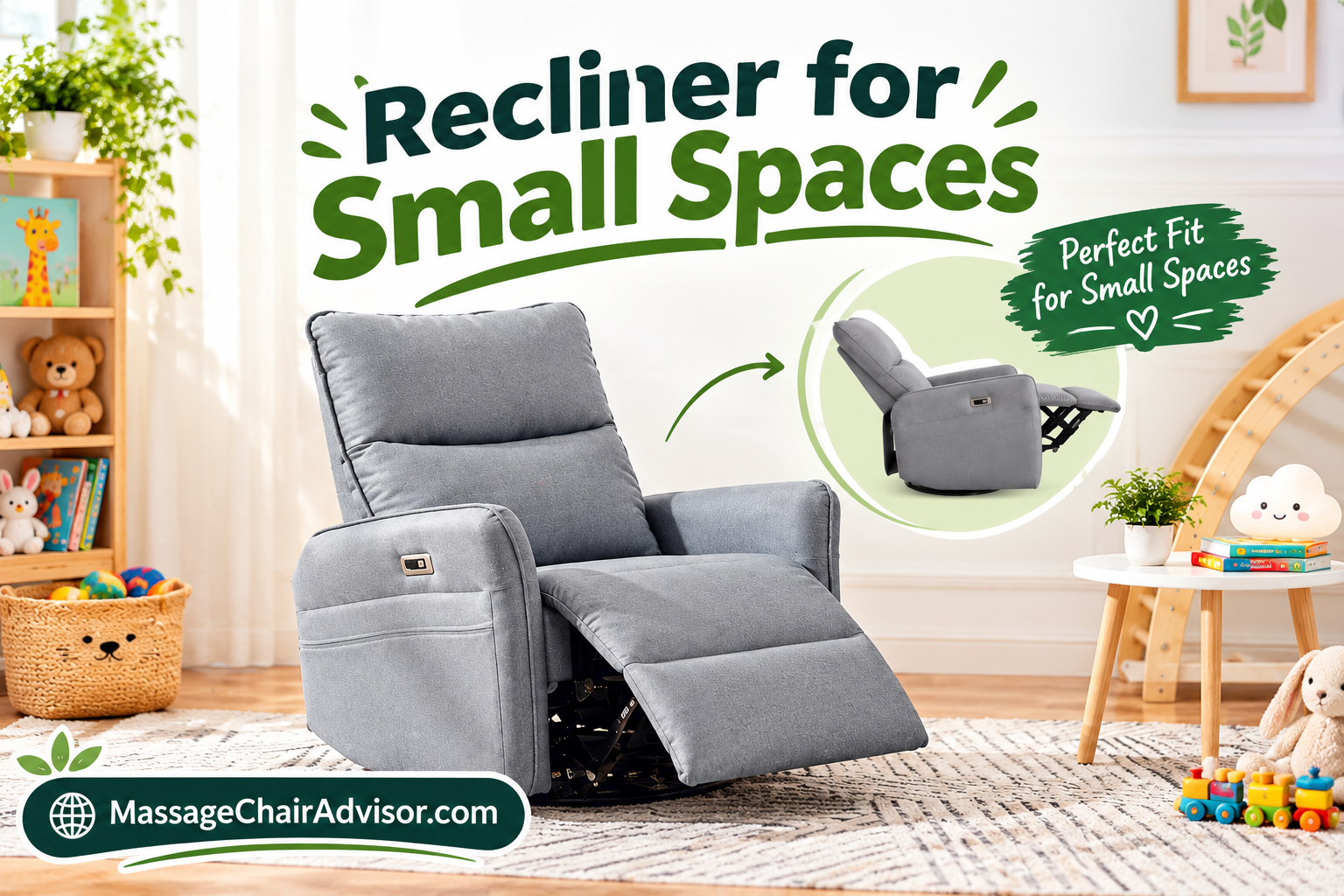
Wall Huggers, Gliders & Compact Picks;
Best Recliner for Small Spaces:
How to Pick One That Actually Fits?
The short answer: the best recliner for small spaces is usually a wall hugger, which reclines with roughly 3 to 6 inches of wall clearance. Compact, swivel glider and slim power models also work well, as long as their fully reclined depth fits your room.
The best Recliner for Small Spaces is often the biggest single piece of seating in a room. In a studio, a condo living room or a bedroom corner, the wrong one blocks the walkway, bumps the wall and makes the whole space feel smaller.
The right one gives you real comfort in a footprint that works. This guide walks through how to measure, which types suit which rooms, what to pay, and how to avoid the mistakes that lead to returns.
What makes a recliner for small spaces right for a small space?
A recliner for small spaces have three things. It fits the room when closed, it fits when fully reclined, and it still supports your body properly.
The second point is where most buyers get caught. Some recliner for small spaces look slim upright but need a lot of open floor once the footrest and back extend. Always check the reclined depth, not just the width and closed depth.
Look for these traits:
- A narrow frame, often around 27 to 36 inches wide.
- Slim or low-profile arms.
- A mechanism built to sit close to a wall.
- A seat height and depth that suit the main user.
- A stated wall clearance on the spec sheet.

How much space does a recliner need?
Traditional recliner for small spaces usually need roughly 12 to 30 inches behind them so the back can tilt without hitting the wall. Wall-huggers need only about 3 to 6 inches. Exact numbers vary by model, so treat these as typical ranges and confirm on the manufacturer’s spec sheet.
| Recliner type | Typical width | Space needed behind to recline |
| Traditional full-size | Often 35 to 42 in | Roughly 12 to 30 in |
| Wall-hugger | Often 30 to 38 in | About 3 to 6 in |
| Compact or petite | Often 27 to 32 in | Varies; many are wall-hugger designs |
| Swivel glider | Often 30 to 36 in | Varies; check the spec sheet |
Keep a main walkway of about 30 inches clear. That is a common interior-design rule of thumb, not a legal standard, but it keeps a room usable.
How to measure your room for a recliner?
- Measure the floor area where the chair will sit, both width and depth.
- Find the reclined depth on the spec sheet and add it to your plan.
- Tape the footprint on the floor with painter’s tape, or cut a cardboard template, to see the true size.
- Walk the room. Make sure doors, closets, radiators and walkways stay clear when the chair is open.
- Measure the delivery path. Check doorways, hallways, stairwells and elevators, plus any tight corners.
- Note the nearest outlet if you are considering a power model.
A simple test: if the taped outline makes you turn sideways to cross the room, the chair is too big.
What is a wall hugger recliner?
A wall-hugger, also sold as a zero-clearance or wall-saver recliner for small spaces, slides the seat forward as the back tilts. That lets it sit close to a wall and still recline fully.
One caution on terminology. Zero clearance is a marketing phrase. Most models still need a few inches behind them, so the label does not mean zero inches.
Wall huggers are widely available from brands such as La Z Boy and Ashley, as well as from retailers like Wayfair and Rooms To Go. They are the safest starting point for most small rooms.

Which type of recliner suits which small space?
There is no single best model for every home. Match the type to the room and the person using it.
Wall-hugger recliner for small spaces:
Best for: apartments and living rooms where the chair sits near a wall.
Pros: minimal wall clearance, wide choice, manual and power versions.
Cons: the open footprint can still extend forward, and entry-level models may feel less plush.
Compact and petite recliner for small spaces:
Best for: corners, reading nooks, home offices and shorter users.
Pros: narrow frames and lower back heights.
Cons: taller or broader users may find the seat too snug.
Swivel glider and rocker recliner for small spaces:
Best for: nurseries and rooms with more than one focal point, such as a TV and a window.
Pros: you can turn the chair without moving it, and the glide is smooth for feeding or rocking.
Cons: the base needs some open floor to rotate, and a highly confined spot may not suit a rocking motion.
Power recliner for small spaces:
Best for: anyone who wants easy operation or precise positions, including users with limited leg or back strength.
Pros: infinite positions on many models, plus extras like USB ports and power headrests.
Cons: they need an outlet or a battery pack, and a cord can become a trip hazard.
Push-back manual recliner for small spaces:
Best for: budget-minded buyers and rooms without nearby outlets.
Pros: simple, quiet, no electronics. Many look like an accent chair when upright.
Cons: less precise positioning, and you need some leg effort to push the back.
Lift recliner for small spaces:
Lift chairs raise the user toward standing and are usually larger than standard small-space models. If the chair is for a medical or mobility need, speak with a healthcare professional or occupational therapist before choosing one.
How do you choose?
A seven-step decision framework:
- Set your limits. Write down the maximum width, closed depth and reclined depth.
- Pick the placement. Against a wall points to a wall-hugger. In the open points to a swivel glider.
- Choose the mechanism. Manual is simpler and cheaper. Power is more convenient but needs electricity.
- Match the chair to the body. Sit with your feet flat. Your thighs should be supported and your back should touch the backrest.
- Choose the upholstery. Think about pets, children, sunlight and cleaning.
- Check the build. Look for a solid frame, a described mechanism and a clear warranty.
- Confirm delivery and returns. A heavy chair that cannot come back is a real risk.
Quick decision guide:
- Chair against a wall: wall-hugger
- Tight corner or nook: compact or petite
- Need to face different directions: swivel glider
- Want easy operation: power
- Tight budget: manual wall-hugger or push-back
Body fit: why seat depth and height matter:
Comfort in a recliner for small spaces depends on proportion. A seat that is too deep leaves a shorter user without back support. A seat that is too shallow leaves a tall user perched on the edge.
Before you buy, check seat height, seat depth, back height, arm width and the stated weight capacity. Good lumbar support also matters if you plan to sit for long periods.
If you are petite or tall, search specifically for petite or extra-tall versions rather than assuming a standard size will work.
Frame, mechanism and materials:
The frame and mechanism decide how long a recliner for small spaces lasts. Kiln-dried hardwood or quality engineered frames, a steel mechanism and a mechanism warranty are good signs.
| Upholstery | Pros | Cons |
| Performance fabric | Stain resistant, good with pets and kids | Texture varies |
| Microfiber | Soft and affordable | Can attract pet hair |
| Faux leather | Wipes clean, budget friendly | May peel over time |
| Bonded leather | Low cost | Often less durable |
| Top-grain leather | Durable, ages well | Higher cost, needs care |
In warm, humid climates, breathable fabric can feel more comfortable than leather. In cold rooms, leather can feel chilly at first.
Power recliners in tight rooms: cords and batteries:
A power recliner for small spaces needs a plan for its cable. Check where the nearest outlet is before you order, and avoid running a cord across a walkway.
Many power models offer a rechargeable battery pack, which removes the cord problem. Some also include USB ports, which are handy near a reading chair.
When you choose a power model, look for recognised electrical safety marks such as UL listing, or the equivalent in your market.
What does a recliner for small spaces cost?
Prices vary by market, retailer and season, so use these as rough category ranges rather than quotes.
| Tier | Typical range (USD) | What you usually get |
| Budget | Under about $400 | Manual or push-back, basic fabric, shorter warranty |
| Mid-range | About $400 to $900 | Better frames, wall-hugger designs, some power models |
| Premium | About $900 to $2,000+ | Power, leather, swivel glide, stronger warranties |
Always compare the total cost. Delivery, assembly, taxes and return shipping can change the final price noticeably.
Real-world scenarios:
A 450 sq ft studio. The sofa and bed already use the floor, so a wall-hugger against the main wall with a slim side table keeps the walkway clear. Light upholstery and slim arms help the room feel open.
A nursery. A swivel glider recliner lets you feed, rock and turn toward the crib or door. Easy-clean upholstery is worth prioritising.
A home office reading nook. A compact manual recliner with a low back fits beside a bookshelf, with no cord to manage.
An outlet-poor condo layout. A power recliner with a battery pack avoids cables across the floor.
A downsizer. A power wall-hugger with firm seat support and simple controls is easier to use daily. Test the seat height in person if you can.
Recliner for small spaces for rentals, staging and commercial use:
Buyers outfitting rentals, short-term lets, staging projects, clinics or hospitality spaces have different priorities. Durability, easy-clean upholstery and predictable delivery matter more than plush styling.
For commercial settings, ask about contract-grade fabrics, warranty terms on bulk orders and lead times. Check the fire-safety rules that apply in your market, such as California’s TB 117-2013 in the US or the UK’s furniture fire safety regulations. For office and contract furniture, BIFMA standards are also widely referenced.
For healthcare or assisted-living use, involve a clinician or occupational therapist when choosing lift or mobility-focused models.
Where to buy and how to test a recliner for small spaces:
Recliner for small spaces are a try-before-you-buy purchase, which is why “recliner store near me” is such a common search. Showrooms let you check what a spec sheet cannot.
Types of sellers include brand galleries such as La-Z-Boy, national chains like Ashley, Rooms To Go and IKEA, warehouse clubs like Costco, independent furniture stores, outlets and medical supply stores. Online retailers such as Amazon, Wayfair, Walmart and Target add choice and price comparison.
When you test a recliner for small space, sit for at least 10 to 15 minutes and check:
- Seat height and whether your feet rest flat.
- How smoothly and quietly it reclines.
- Back support in both upright and reclined positions.
- Whether the footrest stays clear of nearby furniture.
Before ordering, confirm the delivery area, whether room-of-choice placement and assembly are included, and the return window.
Regional notes:
- US and Canada: “apartment recliner” and “condo recliner” are common terms, and large retailers offer many wall-hugger options.
- UK: you will often see “recliner armchair” or “compact recliner chair.”
- Australia: “recliner armchair” and “lounge chair” are common, and delivery distances can affect cost.
- Dense cities: narrow stairwells and small elevators matter more than anywhere else, so ask about white-glove delivery.
Common mistakes to avoid:
- Measuring only the closed size.
- Forgetting to check doorways, stairs and elevators.
- Buying on looks without sitting in the chair.
- Ignoring seat depth.
- Choosing a power model without checking the outlet.
- Placing a swivel chair where its rotation hits furniture.
- Skipping the warranty details.
- Letting the footrest block a door or heating vent.
Safety warning: recliner for small space mechanisms have pinch points and can trap fingers. Keep children and pets clear while the chair is moving, and respect the weight limit.
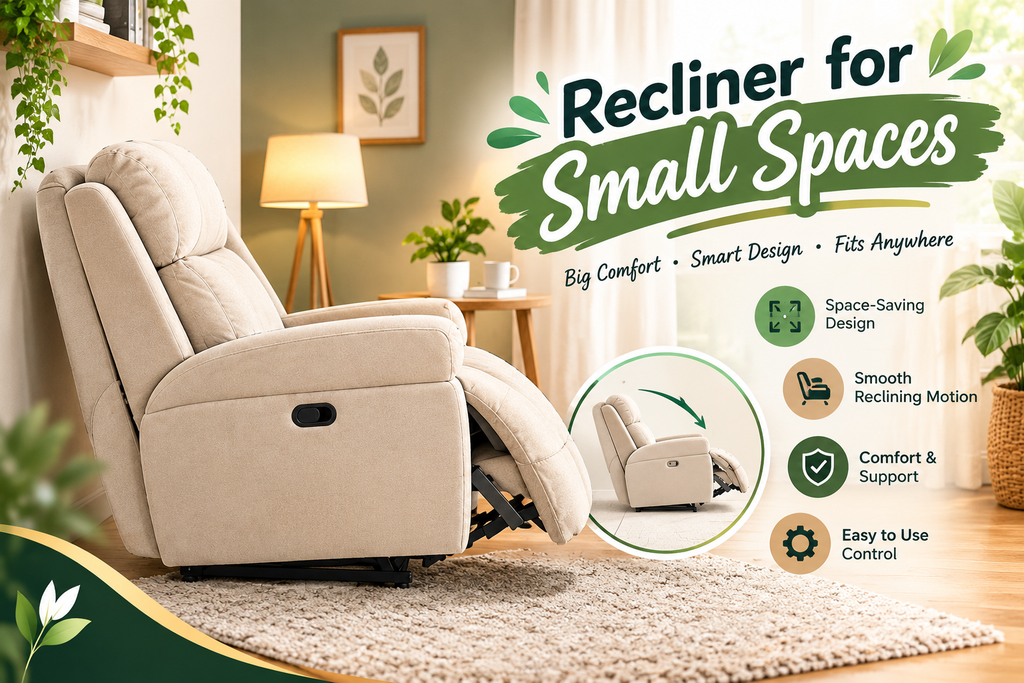
Before-you-buy checklist:
- Measured the space, closed and fully reclined.
- Taped the footprint on the floor.
- Measured doors, halls, stairs and elevators.
- Located the nearest outlet.
- Chosen manual or power.
- Checked seat height and depth for the main user.
- Read the warranty and return policy.
On delivery, inspect the chair before the carrier leaves, test the recline several times and keep the packaging until the return window closes.
Alternatives to a recliner for small spaces:
If the numbers do not work, you still have options:
- Accent chair with an ottoman: a smaller footprint with a footrest.
- Reclining loveseat: seating and recline in one piece.
- Chaise lounge: a relaxed posture without a mechanism.
- Zero-gravity chair: foldable and easy to store.
- Glider without recline: useful for very small nurseries.
How we evaluate recliner for small spaces:
The guidance above rests on a consistent set of criteria: reclined footprint, wall clearance, body fit, mechanism and frame quality, upholstery durability, power and cord practicality, delivery requirements and total cost. Check any figure against the manufacturer’s current spec sheet before you buy.
Frequently Asked Questions:
1. What is the best recliner for small spaces for a small room?
A wall-hugger recliner is usually the best choice, because it reclines with only a few inches of wall clearance. For very narrow rooms, a compact or petite model is worth considering.
2. How much room do you need behind a recliner for small spaces?
Traditional recliners often need roughly 12 to 30 inches behind them. Wall-huggers typically need about 3 to 6 inches. Always confirm on the manufacturer’s spec sheet.
3. Are wall-hugger recliner for small spaces comfortable?
Many are, especially mid-range and premium models with good cushioning and a solid frame. Try one in person for 10 to 15 minutes if you can.
4. Can a recliner fit in a studio apartment?
Yes. Choose a wall-hugger or compact style, check the reclined depth, and keep a walkway of about 30 inches clear.
5. Are power recliners worth it in a small space?
Often yes, because they are easy to use and offer more positions. Make sure there is an outlet nearby, or choose a battery-pack model.
6. Do swivel recliners need more space?
They can, since the base needs room to rotate. Check that the rotation clears nearby furniture and look at the manufacturer’s stated dimensions.
7. How do I measure a recliner for small spaces for my room?
Measure the closed and fully reclined dimensions, tape the footprint on the floor, and measure doorways, hallways and elevators for delivery.
8. How long do recliners last?
Lifespan depends on frame quality, mechanism, upholstery and how often the chair is used. A solid frame and a mechanism warranty are good signs of durability.
9. Are recliners bad for your back?
Comfort depends on fit and support. Choose a chair with good lumbar support and a suitable seat depth, and talk to a healthcare professional if you have a specific back condition.
10. Is a recliner or an accent chair better for a small living room?
If you want a leg-lifting recline, choose a recliner for small spaces. If a minimal footprint matters most, an accent chair with an ottoman may fit better.
Conclusion:
The best recliner for small spaces is the one that fits your room both closed and fully reclined. For most people, that means a wall-hugger. For tight corners, go compact. For rooms that need flexibility, a swivel glider is a strong choice.
Measure first, tape the footprint, check the delivery path, then test the chair in person if possible. Do those four things and you will avoid the most common returns.
Unfulfilled Points: original open-versus-closed footprint diagrams, a named author profile, hands-on testing notes and a last-updated date could not be created within the article text. Specific model recommendations were avoided because current product specifications and prices could not be verified.
These information about best recliner for small spaces are gathered from different surveys, medical tests and tech giants like Reviewed and more. Our top priority is to provide you valuable information about best recliner for small spaces.
For More Details About Different massage chair Click Here.